Showing posts with label CASE Advance. Show all posts

Tuesday, March 11, 2014

Behind the Scenes: A Social Media Manager's Experience

My phone started buzzing at about 9:10 p.m. on Monday night. One notification, then two, then three... I checked in on Twitter and discovered that Rich Peverley, a St. Lawrence alumnus, had collapsed during the Dallas Stars game.

The messages began pouring in. Being St. Lawrence's social media manager is an absolute privilege, and of course I sent out a tweet from @StLawrenceU to show our support. But it's what everyone else was posting and sharing that meant the most - and more often than not, no one sees all of those posts except me.


One of my goals this year has been to find ways to let people into my little social media world when I could and share what I experience because sometimes, I feel a little selfish that I'm the only one that sees it and is able to feel the sentiments in real time. I knew I couldn't retweet everything from last night; but even if I could, those tweets on their own don't tell the same story as all of these posts put together.

So, here it is - an illustration of Laurentian pride and our spirit, all compiled into one place thanks to Storify and social media. Get better, Rich!

Wednesday, January 15, 2014

A Thank You & 12 Cents Go a Long Way

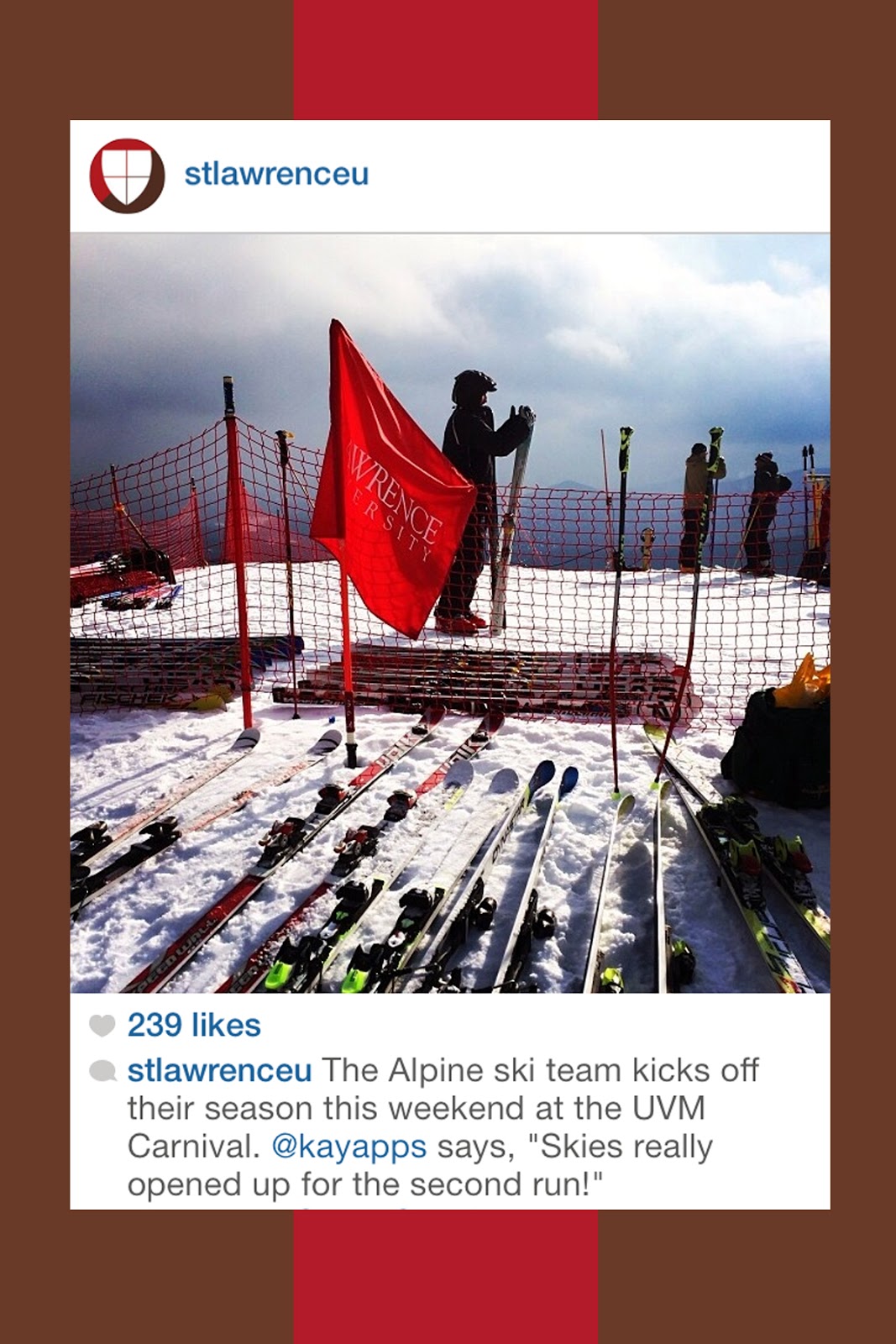
A while ago, I blogged about some frustrations with Instagram and how it's not as social as I'd like it to be. I want to "retweet" a community member's photo so they can experience ALL THE LIKES instead of me! But alas, Instagram hasn't built this feature in yet.

So the question for me became, "How can we share these likes and this awesomeness with the people whose content we're sharing so they know they're appreciated?"

I started by sending emails to people thanking them, but that only goes so far. After all, how many emails do we get a day? When I expressed my frustrations with my student social media team, one member came up with a great idea: thank you postcards, featuring that student's Instagram post.

Um. Brilliant.


When I share a community member's photo on the main St. Lawrence account, I wait a few days until the vast majority of the likes have come in, then take a screenshot of the post as it appears on our account and open it in Photoshop on my PC.

I built a high-resolution 4" x 6" template in Photoshop that looks like the university's flag (shown), then take the screenshot and place it on top. (Note: I am no whiz in Photoshop, as you can see. Just think how much better you can do!)

I upload the finished product to my phone and head to the local drugstore, which has a wonderful Kodak kiosk that prints these for 12 cents a pop and has them all printed for me in under five minutes. They look fantastic, too!

Cards moments before being sent!


Once printed, I hand write notes on the back, thanking the user for letting us repost the photo. I always make sure I find something that makes the post unique - was it in the Top 5 liked photos ever? Top 10? Did someone leave a great comment on it? I share those tidbits in my note. I always sign it "@StLawrenceU" (word on the street is they love that!). I then send them via campus mail (we're a small residential campus) to their on-campus mailboxes.


This is typically the reaction I see when a student finds one of these in his or her mailbox:


We don't just do this for students - I've done this for faculty and staff, too. When the day comes and we share an alum's photo, they'll get one in the snail mail, too. Who doesn't enjoy getting a random love note in the mail from their alma mater?!

In terms of social media currency, I learned early on that "liking" a student's photo got us some great street credit (and helped us earn trust on the platform and elsewhere, too). When we started asking to repost, it upped the social ante and we found a lot more students using the hashtag and directly tagging us in their posts, hoping we'd share. Now students are posting these cards when they get them. They can hold in their hands how much we value them. This goes so much deeper than a mention or a repost - it's on a whole different level.

I know; doing this is just a little thing, a very, very small part of what I do. There are no analytics to measure here, no way to assign any "tangible" value or ROI. My only takeaway is that this little thing could be making someone's day. And I'm perfectly content with that being the only outcome.

A huge shout out to Lexi Williams, a student here at St. Lawrence University; I may be able to write this post and share it with you all, but she's the one who had this idea. I refuse to take any of the credit as it all needs to go to her and my student team (and in case you were wondering about the value of getting students involved with your work, here's a great example of why. They have the best ideas!).

What ways do you thank your community members for sharing content?

Monday, November 11, 2013

Lock the Door or Open It? Why My Digital Identity is Public

Who should I be in digital spaces? Should I friend or follow students I know and/or work with? Should I accept students’ requests? Should I make my accounts private so they can’t follow me? What are my boundaries when it comes to social media?
When I presented at a higher education student affairs conference several weeks ago, these were some of the questions I was asked. They are questions that, at one time or another, I’ve also asked myself. I don’t work in student affairs, but as the social media coordinator on my campus, I work with a number of students and meet more every day. Because of this, I had to stop and think about if it was appropriate to keep my personal accounts public for this potential audience to see.
After wrestling with these thoughts, I decided to be completely public in my personal social media use. Here are three reasons why.
I don’t post inappropriate content. We’ve seen the stories about people who share too much on social media and the consequences of doing so. If I’m using social media—public accounts or private ones—the content is still out there, it has my name on it and the consequences remain the same regardless of the type of account.
A big part of who I am is the work I do. The lines blur for me when it comes to social media. When I am reading through tweets and catching up on what people in higher ed are saying , I’m doing it because it’s my job but also because I thoroughly enjoy learning about it, often in my free time. Finding the time to manage multiple accounts to separate these aspects of my life seems disingenuous because it’s not who I am. I don’t turn off work and turn on life or vice versa, so why would I do that on social media? (This also potentially uncovers a work-life balance issue I may need to address, but that’s for another post.)
But my biggest reason for keeping my accounts public is that I see it as a chance to educate. How often are students getting real-world lessons on how to develop their social and digital identities? I want them to see me engage in weekly Twitter chats and live-tweet from conferences. I want them to see how I use social media to network and collaborate with colleagues from all over the country. I want them to see how passionate I am about the work I’m doing with them and for them. This is an opportunity for me to educate them on how to use social media responsibly in a world where this type of education is so scarce, yet so necessary. Who knows? Seeing how much I love my work might inspire one of them to pursue a similar career path. At the very least, they are getting ideas on how they can use social media beyond what the typical college student uses it for.
In the conversations I had with colleagues at the conference, I learned that many institutions have social media rules and guidelines for those who work in student affairs, guidelines which are also welcomed by staff members because they deal enough with students as it is! In the end, it all comes down to what you’re comfortable with. But the next time a student requests to follow you on Twitter or friend you on Facebook, consider how you use those spaces and how much they could learn from you about the work you do by letting them in. You just might inspire the next generation of higher education professionals.
How do you handle your professional and personal digital identities? What are your thoughts on interacting with students on social media platforms?
This article was originally posted on the CASE Advance blog.