Thursday, March 6, 2014

What One Prospective Parent Wants to See from Colleges on Facebook


You know that feeling you get when you get a long private message on your university’s Facebook page? For me, it’s mixed – is it going to be a request to post something? Did I do something wrong? Did I do something great? Is it some kind of emergency?

Last week, it was a message from a prospective student’s mother who had some questions about our university and wanted to know about our arts programs and hadn't found much on Facebook. I messaged her back, answered her questions and thanked her for her feedback. Then I asked if there was anything else I could help her with. She asked why some colleges post certain types of content and others don’t. I looked at this as a fantastic opportunity to pick her brain a little bit, and after telling her a little bit about what I try to do with our Facebook page, I asked her what she, a prospective parent, is looking at and for when she is researching a college on Facebook (because yes, this proved to me they are researching colleges on Facebook).

These are some of the highlights (in the order she mentioned them):
  • What’s NOT in the glossy handouts: Like students, parents want a real-feel for our campuses, and that perspective often comes from anyone but the colleges themselves (even though we try!). She spends time reading comments to get a sense of how authentic a college is being based on their community’s reactions to their posts (and also noted how we, as a university, respond to those reactions and comments). She also looks at what other people post to the page – not just posts by the university.
  • How a community responds to tragedy. How quickly do you post during an emergency or following a tragedy affecting your campus? She noted that some schools she’s looked at try to shy away from sharing tragic news and she took note of this in a negative way, but applauded others that did post - and did so in a timely manner. She also said she could get a sense of the college and its community by how people commented and responded to such news. Did a lot of people comment? How did they comment? Were they reacting negatively to the timing of the news being shared (was it posted too late)?
  • Show me the student experience. This parent wanted to know more about what Orientation is like, the community service opportunities, the town (or city) the college is located in and where students could study abroad. Are sports popular? I read this as: Will my child fit in? 
  • Current campus news. Who are your professors and what are they doing? What are your students up to? Is there construction? What does that look like? When will it be completed? I got the sense she’s looking for a college moving forward and that the college regularly showcases that through news and photos. (No mention of rankings.) 
  • What are the hot issues? She mentioned she enjoys reading articles from the college’s student newspaper so she could get a real sense of what the college and students are like without the marketing/PR filters on them. (Do you see a pattern? Authentic content is critical.)
  • Campus photos. We know this one. (No girls under trees, please.)
  • Photos and videos taken by students. Again with the authenticity!
There aren’t many surprises here, but it was refreshing to get an outside perspective from a constituent I don’t often hear feedback from. It reaffirms our work in trying to be as authentic as we can be but was also a good reminder that it’s often what people are saying to us and about us - and how we respond to those comments - that tells people outside our community who we really are. 

Wednesday, January 15, 2014

A Thank You & 12 Cents Go a Long Way

A while ago, I blogged about some frustrations with Instagram and how it's not as social as I'd like it to be. I want to "retweet" a community member's photo so they can experience ALL THE LIKES instead of me! But alas, Instagram hasn't built this feature in yet.

So the question for me became, "How can we share these likes and this awesomeness with the people whose content we're sharing so they know they're appreciated?"

I started by sending emails to people thanking them, but that only goes so far. After all, how many emails do we get a day? When I expressed my frustrations with my student social media team, one member came up with a great idea: thank you postcards, featuring that student's Instagram post.

Um. Brilliant.


When I share a community member's photo on the main St. Lawrence account, I wait a few days until the vast majority of the likes have come in, then take a screenshot of the post as it appears on our account and open it in Photoshop on my PC.

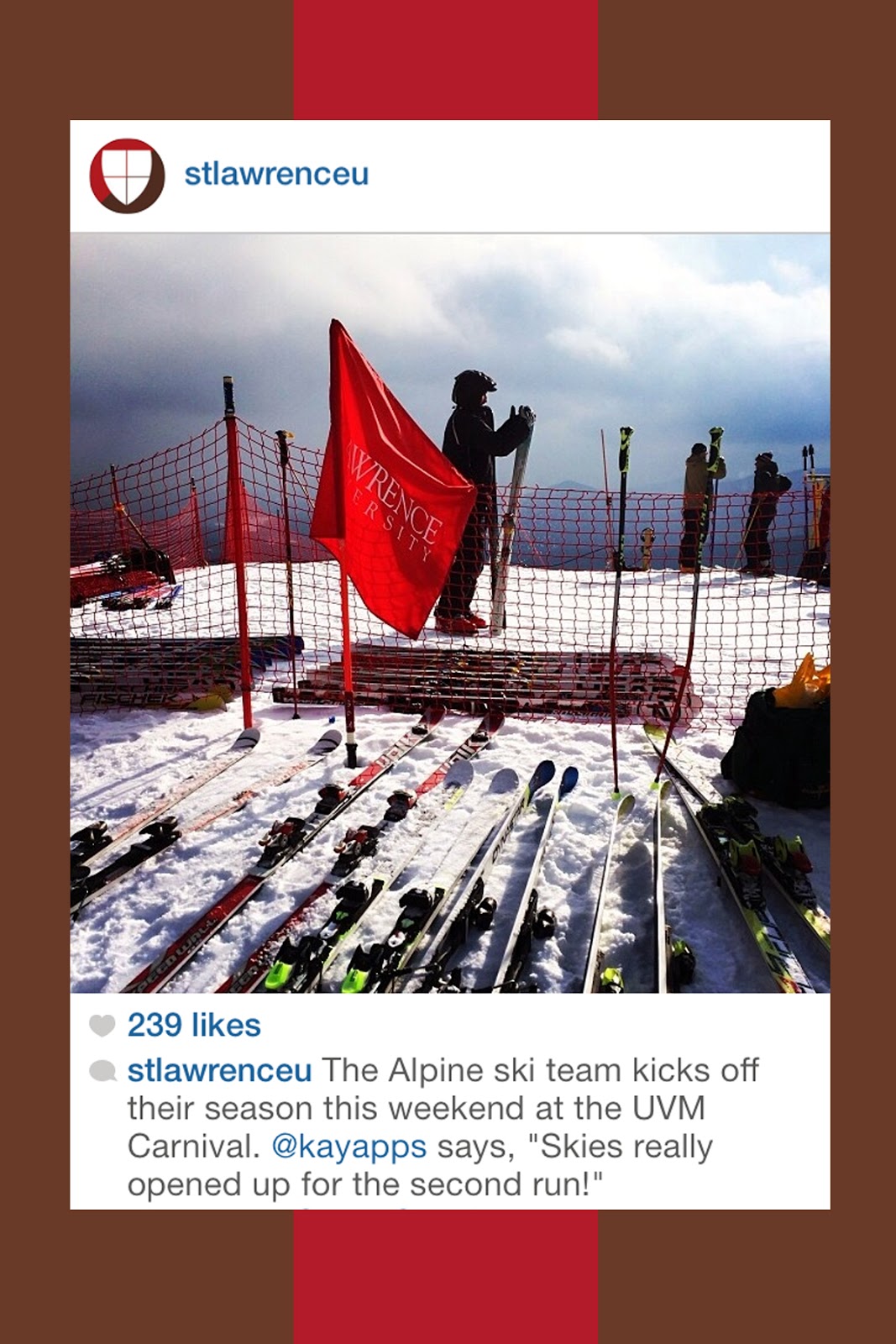
I built a high-resolution 4" x 6" template in Photoshop that looks like the university's flag (shown), then take the screenshot and place it on top. (Note: I am no whiz in Photoshop, as you can see. Just think how much better you can do!)

I upload the finished product to my phone and head to the local drugstore, which has a wonderful Kodak kiosk that prints these for 12 cents a pop and has them all printed for me in under five minutes. They look fantastic, too!

Cards moments before being sent!


Once printed, I hand write notes on the back, thanking the user for letting us repost the photo. I always make sure I find something that makes the post unique - was it in the Top 5 liked photos ever? Top 10? Did someone leave a great comment on it? I share those tidbits in my note. I always sign it "@StLawrenceU" (word on the street is they love that!). I then send them via campus mail (we're a small residential campus) to their on-campus mailboxes.


This is typically the reaction I see when a student finds one of these in his or her mailbox:


We don't just do this for students - I've done this for faculty and staff, too. When the day comes and we share an alum's photo, they'll get one in the snail mail, too. Who doesn't enjoy getting a random love note in the mail from their alma mater?!

In terms of social media currency, I learned early on that "liking" a student's photo got us some great street credit (and helped us earn trust on the platform and elsewhere, too). When we started asking to repost, it upped the social ante and we found a lot more students using the hashtag and directly tagging us in their posts, hoping we'd share. Now students are posting these cards when they get them. They can hold in their hands how much we value them. This goes so much deeper than a mention or a repost - it's on a whole different level.

I know; doing this is just a little thing, a very, very small part of what I do. There are no analytics to measure here, no way to assign any "tangible" value or ROI. My only takeaway is that this little thing could be making someone's day. And I'm perfectly content with that being the only outcome.

A huge shout out to Lexi Williams, a student here at St. Lawrence University; I may be able to write this post and share it with you all, but she's the one who had this idea. I refuse to take any of the credit as it all needs to go to her and my student team (and in case you were wondering about the value of getting students involved with your work, here's a great example of why. They have the best ideas!).

What ways do you thank your community members for sharing content?

Monday, November 11, 2013

Lock the Door or Open It? Why My Digital Identity is Public

Who should I be in digital spaces? Should I friend or follow students I know and/or work with? Should I accept students’ requests? Should I make my accounts private so they can’t follow me? What are my boundaries when it comes to social media?
When I presented at a higher education student affairs conference several weeks ago, these were some of the questions I was asked. They are questions that, at one time or another, I’ve also asked myself. I don’t work in student affairs, but as the social media coordinator on my campus, I work with a number of students and meet more every day. Because of this, I had to stop and think about if it was appropriate to keep my personal accounts public for this potential audience to see.
After wrestling with these thoughts, I decided to be completely public in my personal social media use. Here are three reasons why.
I don’t post inappropriate content. We’ve seen the stories about people who share too much on social media and the consequences of doing so. If I’m using social media—public accounts or private ones—the content is still out there, it has my name on it and the consequences remain the same regardless of the type of account.
A big part of who I am is the work I do. The lines blur for me when it comes to social media. When I am reading through tweets and catching up on what people in higher ed are saying , I’m doing it because it’s my job but also because I thoroughly enjoy learning about it, often in my free time. Finding the time to manage multiple accounts to separate these aspects of my life seems disingenuous because it’s not who I am. I don’t turn off work and turn on life or vice versa, so why would I do that on social media? (This also potentially uncovers a work-life balance issue I may need to address, but that’s for another post.)
But my biggest reason for keeping my accounts public is that I see it as a chance to educate. How often are students getting real-world lessons on how to develop their social and digital identities? I want them to see me engage in weekly Twitter chats and live-tweet from conferences. I want them to see how I use social media to network and collaborate with colleagues from all over the country. I want them to see how passionate I am about the work I’m doing with them and for them. This is an opportunity for me to educate them on how to use social media responsibly in a world where this type of education is so scarce, yet so necessary. Who knows? Seeing how much I love my work might inspire one of them to pursue a similar career path. At the very least, they are getting ideas on how they can use social media beyond what the typical college student uses it for.
In the conversations I had with colleagues at the conference, I learned that many institutions have social media rules and guidelines for those who work in student affairs, guidelines which are also welcomed by staff members because they deal enough with students as it is! In the end, it all comes down to what you’re comfortable with. But the next time a student requests to follow you on Twitter or friend you on Facebook, consider how you use those spaces and how much they could learn from you about the work you do by letting them in. You just might inspire the next generation of higher education professionals.
How do you handle your professional and personal digital identities? What are your thoughts on interacting with students on social media platforms?
This article was originally posted on the CASE Advance blog.

Monday, October 28, 2013

Students Taking Over = Insta(gram)-Success

Over the summer, I was trying to get out of my own way. When you work in marketing and communications at a school you love, you want the stories and people who make that place great to be what shines through, not a bunch of marketing jargon. I'm lucky that our students love this place and more often than not, they're able to tell our stories better than I could. It was time to let them do that.

I looked at where we've been successful this year on social media and Instagram was the clear winner - it's the one place our students have really engaged with us and it was the first platform where they felt comfortable doing so with any of our "official" accounts. I'm a one-woman show when it comes to our social media efforts, so there's no way I could ever be at every event or game to capture those quintessential St. Lawrence moments for our main Instagram account. Our students often are. That's why @herewegosaints was born.

After talking with my colleagues and with the guidance of my student social media team, we launched our second Instagram account, which is taken over by a new student each week and open to any student who is interested in volunteering to do it. It would open up a lot of opportunities for us to tell the collective St. Lawrence story in an authentic way while celebrating the experiences of our students (and validating those experiences and them, which is something that is very important to me. Yay students! You're so wonderful). Our students are all over Instagram, love it when we like their photos, and like it even more when we ask to share them. This was our chance to show them we value and trust them.

Have I had concerns? Sure. It's always nerve-wracking when you're trying something new and doing so with students driving the project - but that's where you get the best results. I was nervous this wouldn't catch on or that we wouldn't get enough students interested in running the account. My team (five students) and I decided they would be the first set of students to run it so we could get a sense of the issues we might face and whether or not it would resonate with students. If it didn't work, we could just shut it down before anyone really knew about it. The first member of my student social media team took it over on September 30, just four weeks ago today.

We've done minimal advertising of the account. I posted a screenshot of the account on our main Instagram account a few days into our first week with it and each Monday when someone new takes over, I tweet the name of the student running the account. The lack of advertising has been deliberate to see if word-of-mouth was enough to propel this project forward. Was it going to be edgy enough to withstand our college's "cool" factor?

When I posted the screenshot on our account, the response to the post was minimal - 30-40 likes when our posts typically average about 200 likes. For a second I was worried, until I noticed they were following the new account instead. In four hours, the account jumped from 25 followers to over 200. Since that day, we've nearly tripled that number and reached 535 followers as of this post. For a school with just 2,400 students, this growth has been outrageous for us (I should note it took our main account more than three months to reach that many followers). On Friday, our student newspaper did a great feature on the new account - it's the first time any of our social media projects have gotten any ink. That's a win in my book.


My student team says there's been a huge buzz about it on campus since it was launched. A lot of students asked them what it was like to run it and how they could do the same. The rules are simple and I require each student who wants to take it over to meet with me so they know who I am and can ask any questions they have. My student team has made a lot of recommendations of people they know we could trust with it, and I've received several emails from interested students. They're excited, and that makes me excited.

Some interesting tidbits: My student team members are comprised of juniors and seniors, so I don't often remember they may have siblings or friends in high school. When one of my team members took it over for the week, she highly publicized her takeover of the account on her personal accounts. What I didn't expect was her sister, a high school senior, to share it. She created an image telling her high school friends to follow the account, too, since her sister was running it. (Mind blown yet? Mine was. I can't make that kind of awesome - and free! - promotion up.) On that one day alone, we gained more than 130 new followers. (In related news, who wants to hire this girl? I do.)


A few members of my student team are also admissions ambassadors and have been sharing this new account when meeting and communicating with prospective students. They love knowing they can follow an account run by students instead of an institution-run account. I'm interested to see where this goes as a recruiting tool for us - I know our admissions colleagues have started spreading the word about it, too.

I was also shocked by the incredibly positive reaction I've gotten from our alumni. One said, "Meg, I actually search for the account on Instagram to make sure I haven't missed anything." Who could ask for anything more in a new endeavor? All parts of our community audience are enjoying this, not just the people it was created for.

While I've enjoyed having a controlled group of students that I know running the account these first four weeks, I'm really excited to meet new students across campus and let them run with it. I think the fact that we have opened this up to people who are interested and not just my team is a critical part of its popularity. An account run by the team would be cool, but it would still be seen as "controlled" posts and messages. I'm excited to experiment with this approach. Do I expect hiccups? Yes. But I expect even more awesome (and that'll cure those hiccups any day).

Have questions? Want to learn more? I'll be presenting about this during the HigherEdExperts' Social Media Conference on December 4. Sign up (by Nov. 16!) and tune in to find out how this project has progressed - another plus is you'll listen to 11 of the people I admire most in higher education present on their own work. It's a win-win!

You can also reach me by leaving a comment below or by email: megan.bernier@gmail.com

Wednesday, September 18, 2013

Is Instagram Really "Social"?

I appreciate people who are taking the time to investigate social media platforms' Terms of Service like Karine Joly, who has started a weekly "Social Media TOS Tuesday." She recently blogged about Instagram's Terms of Service (TOS) and what we can and can't do on our brands' accounts.

One of the points Karine made was that re-posting other users' content on your account violates Instagram's TOS. I've seen many colleges and universities doing this and doing it well - many ask for permission to re-post and then credit the person behind the original post, which I think is a critical piece to going this route. But this is frowned upon by Instagram because it's not the brand's original content.

This is also true on Facebook. Creating a Facebook album of your community's best Instagram photos also violates the TOS, unless you're using an API or linking directly to the person's content. For our community, students don't want us necessarily linking to their accounts. In talking with some of our students, they'd love for us to post their content, but even though their accounts are public (since we can see their content), they don't want just anyone looking at them. 

Learning all of this was a real eye-opener for me as Instagram has become a very popular tool for us and where we've had a lot of success in the last 10 months. It's made me question Instagram: Does their TOS allow us to be truly "social" on the platform?  Karine's posts leave me extremely frustrated with Instagram (not with her, of course!) and thinking undoubtedly yes because in many ways, they don't allow us to foster a community of sharing and engagement like we've been trained to do with other tools. Rather, the platform focuses on metrics such as simply "liking" photos, something I don't think means much at all..

In higher education, many social media "teams" and managers are actually one-person shows who can't be everywhere at once and not always around to grab that perfect sunset photo or events that students are capturing every day. Re-posting photos is a way to show your community the bigger picture of your brand (and crowd-sources, which often yields much better content!) and I'd think would make the content creator feel really good about what they're doing and feel even better about your institution.

I'm all about giving credit where credit is due, which is what this all comes down to - I don't care about likes or comments on our own posts, but pushing out great content that reflects who we really are -that's what social media is all about. I think linking to a person's Instagram account in the caption/comments, you're linking people back to the original content creator. Should that violate anything?

If we choose to follow Instagram's TOS, it really limits us in what we're doing for our community. If they created a re-post option where the person's work that was re-posted received all the likes and comments, then great! I actually like that better than the idea of a brand getting all the engagement for another's work. They should be the ones seeing and relishing in that. Then they'd see how valued their work is and be really proud. Our community wants that and in my fantasy social media world, I'll hope for a resolution of some kind as Instagram evolves - either in creating a re-post option or amending the TOS.

Until then, for those schools or brands who have found success in re-posting, will you continue doing so? What are you doing to stay in check with Instagram's TOS, if anything?

Monday, September 2, 2013

The Most Valuable Share

It's hard to admit this, but I'm a hoarder. 

Okay, so maybe not one in the A&E sense, but when it comes to content I've come across on social media this last year, I've been really selfish. 

As the main social media manager on campus, I get to see what prospective students, current students, faculty, staff and alumni say about us every day and oftentimes engage with those people. At the end of the day, unless I retweet or share the posts, the only people seeing these interactions are just those involved - often me and one, maybe two other people -  and a few followers. And it only exists in these social media vacuums.

So one of my goals this year is a rather simple one - share more of our awesome content, but not necessarily in terms of sharing on Facebook and Twitter; my goal is to do more sharing outside of social media.

This is something I've been thinking about since the spring after I printed out a couple of our Facebook posts about staff members and alumni that received a ton of positive, encouraging comments and physically shared the post with those staff members and alumni. These people, who wouldn't have come across these posts otherwise, got to see they were valued. It was sharing this information beyond the confines of social media platforms that generated (what I would argue to be) the most exciting and emotional kind of engagement I can provide in the work I do.

This goal was solidified during an experience I had this week. A first-year student posted an Instagram photo of a gift our Alumni Council gave him and his classmates at Matriculation. The caption thanked the Alumni Council specifically, so I shared the post with the staff liaison on campus in hopes she would share it with some members of the Council. She shared it with everyone and moments later, a Council member commented on the photo, "On behalf of the entire Alumni Council, you're most welcome." 

I'm sure I'm not the first social media manager making a commitment to doing more of this kind of sharing. I work on a small campus and in a tight-knit community so it's a little easier for me to do this. It may take some extra time, but when you're putting a smile on a staff member's face or allowing alumni who volunteer to see a student cherishing their efforts, it can only do good things for them, us and the communities we're so proud to be a part of.

These shares won't do anything to boost our EdgeRank or post reach, but I'm guessing they will be appreciated by those on the receiving end. No analytics report could ever assign a number or statistic to that.

Saturday, June 8, 2013

Ensuring Value and Purpose in a College's Instagram Contest

Knowing Instagram was the most popular platform our students were using on a daily basis and getting inspiration from several colleges (most notably Elizabethtown College and Donna Talarico's work),  my student social media team and I decided it was time to do something fun on the photo-sharing platform. So in April, we hosted our university's first ever social media contest - an Instagram photo-a-day challenge.

We joined Instagram in late October. I spent the first five months listening to, learning about and educating our audience on there, so I was excited to try this. But I didn't want to do it just to do it, or to get more followers, or something else that didn't mean anything. So how could we do something fun AND have it be valuable for both our audience AND the University?

Strategy

For our audience, it was a game: post a photo every day using #SLUphotoaday that correlated to that day's theme. For my team and myself, it was strategically planned. We chose April for a few reasons:
  • April is the first month in Northern New York that you  might - MIGHT - see signs of spring and not a whole lot of snow.
  • Our University's birthday is April 3.
  • It's a busy month on campus with Springfest Weekend, sports contests, end-of-year concerts, etc.
While these factors definitely played a role in why we chose April, the biggest thing for me was that April is a critical month in the admissions cycle. Why not encourage students to post content every day that you can feature all over the web at the same time high school students are making their college decisions?

The other part of the strategy was deciding on each day's theme. (I should note - they had the best ideas. Another reason to get students involved!). The pride our students and alumni have in this place is incredible; playing off that was going to be key to making this 'cool' and something our students would participate in.


Promotion

We started promotion just five days before April 1. We printed a 120" x 45" banner and hung it in our student center with each day's theme. We posted the contest on Instagram and Facebook. We made fliers for the residence halls. Other than that, I charged the team with sharing the news word-of-mouth.

What happened?

The next month was a whirlwind (hence the month-long delay in posting this). I could go day-by-day, but this post is already long enough. Here are some highlights:
  • We had more than 135 people play (I know there were people I couldn't see playing because of private accounts) and close to 1,200 submissions.
  • In the first seven days, we had over 500 submissions. On Day 3 (our university's birthday), I tallied over 100 photos posted - the most of any day.
  • Our followers grew 27.3% in that one month.
  • Not only did students play, but several alumni played (a few played every day!) and we even had a parent take part in the daily fun. That was a surprise, since the daily themes were really geared toward those on-campus. I was blown away at the lengths some alumni (and the parent) went to play every day! 
Why was it valuable for us?

In my opinion, I think this project was the first time our audience saw us giving them something fun to do and in return, it gave us some street credit with our students and younger alumni. While I've seen increased engagement since taking over our social media efforts in August, it's been more so on the alumni side than with our students. That has slowly changed, but April was sort of a mini social-revolution for us.

Since the beginning of the contest, students have been interacting and talking with us much more frequently. They are tagging us in their photos and posts. We are communicating and sharing together! When we've asked our audience for photos or content, I've seen a jump in the number of submissions we get. For me, it was a great way to end a year of social media growth on campus and I think set the stage for an even bigger social media 'boom' here this upcoming year.

I think it's important to point out here that while we saw an exciting jump in followers, this was not a goal for us. We didn't get 230+ new followers because we ran a contest; we earned the trust of 230+ new followers because we provided exciting and relevant content in an engaging way and encouraged others to join us in doing so.


Other Fun Points to Note
  • When sharing photos on Facebook and Twitter, I saw a jump in new people playing or others playing again.
  • I saw a slight increase in new followers on Admitted Student Days, most likely because students visiting saw the large poster in the student center and heard tour guides talking about the contest.
  • Really thinking about the daily themes and how they could help us share St. Lawrence with others paid off incredibly for us in terms of re-purposing content. For instance, on our university's birthday, the theme was "What I love about SLU." We had more than 100 posts and shared the best in an album on Facebook later that week as it was the perfect way to capture why our audience loves us, instead of us preaching about why we're so great.
  • Remember that "official" Instagram hashtag I spent a long time educating our audience on? Before April 1, less than 350 photos used the tag. By the end of the month, we were close to 700. Far more students are now using the hashtag than they were before, which means I'm finding their awesome content faster and easier (and others are, too).
  • We've had several requests to do it again - so people liked it!
Why was it valuable for them?

You mean besides the prizes? We used a ton of student content we got from participants on other platforms and a number of students took to social media to express their happiness about it. By liking their photos, commenting on them and sharing them, we validated their efforts. They felt appreciated, which was great - because they were (and are).


People also enjoyed seeing how others saw St. Lawrence. Why did their friend love St. Lawrence? Where is everyone's favorite view? Our community learned more about each other in a fun way.

Again, I think because we spent the time to make sure the themes were centered around what makes SLU special and because it was done at the end of the semester, it offered our audience a chance to reflect and appreciate this place. We even heard as much from participants on the last day.


For the Next Time

Of course, this wasn't perfect. We will definitely make adjustments, but based on the number of requests I've gotten from students and departments to do something similar, we'll be doing more things like it - keeping in mind the value to us and the value for them.

Another lesson learned? The weather gods are never on your side. We chose our daily themes six weeks in advance and we picked one day to be themed "Today's Weather," hoping it would be a gloriously sunny day. What we did was jinx ourselves.


Technically, our contest had 15 winners, but I think St. Lawrence and - more importantly - our audience won.

Have questions about what we did? Insights on other successes? I'd love to hear them! Feel free to reach out to me or leave a comment.